A Technical Orientation for Climate-Resilient Engineering
Practising engineers gathered at the Pakistan Engineering Council's regional office in Peshawar to learn the Multi-Hazard Structural Health Assessment method at the heart of CD-CRI.
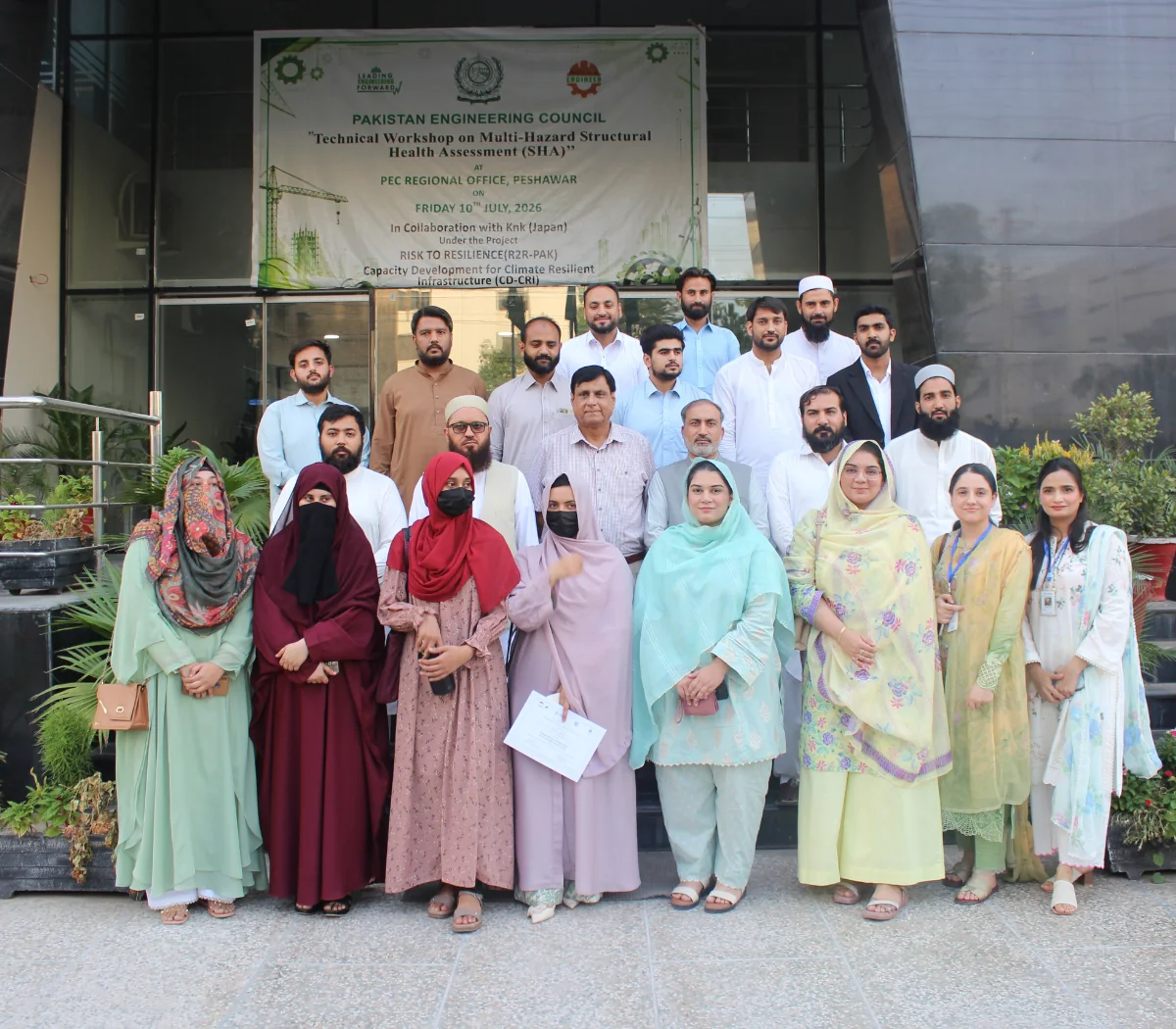
PEC-registered engineers work through the Multi-Hazard Structural Health Assessment method at a CD-CRI technical orientation in Peshawar.
Photo: KnK Japan
On 10 July 2026, KnK Japan convened a Technical Orientation Workshop on Multi-Hazard Structural Health Assessment at the Pakistan Engineering Council's regional office in Peshawar. The workshop was designed to move the CD-CRI approach from framework to field practice, giving PEC-registered engineers a shared, code-aligned method for judging how public buildings would perform under earthquakes, floods and other hazards. It built directly on the Structural Health Assessment system launched at the Islamabad consultation earlier in the year.
The session focused on the practical skills engineers need to carry out consistent assessments: reading a building's structural characteristics, recognising the tell-tale signs of vulnerability, and recording findings in a standard, data-driven way that can be compared across facilities and districts. The methodology is anchored in the Building Code of Pakistan 2021, which adopts internationally recognised benchmarks including ASCE/SEI 41-17 for the seismic evaluation and retrofit of existing buildings, and it reflects the wider ASCE and FEMA-ATC screening traditions on which the CD-CRI SHA system draws.
By training the professionals who will conduct assessments on the ground, the workshop advances one of CD-CRI's core aims, the certification of a cadre of engineers and planners equipped for climate-resilient and disaster-risk-reduction-compliant practice. It also strengthens the link between KnK Japan's project and the PEC's own mandate to raise technical standards across the profession, so that resilience thinking becomes part of routine engineering judgement rather than a specialist add-on.
The orientation forms part of a sequence of CD-CRI capacity-building activities in 2026 that reaches from senior engineers to university students, ensuring that the SHA method is understood and applied consistently at every level of the infrastructure system.