
Seeding Resilience in the Engineering Classroom
A two-campus seminar series took the Multi-Hazard Structural Health Assessment method to engineering students and faculty in Peshawar and Taxila.
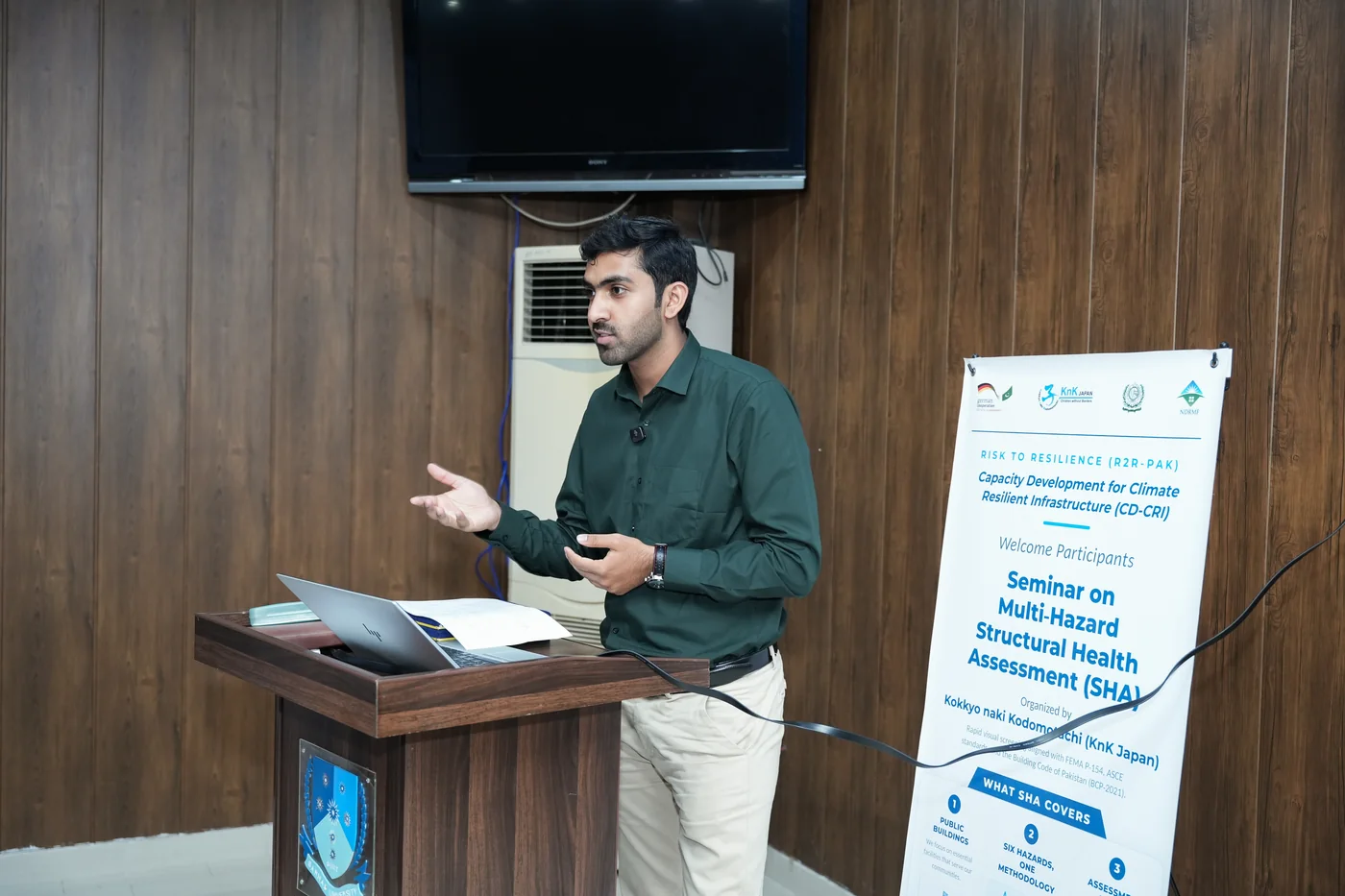
Engineering students engage with the Multi-Hazard Structural Health Assessment method during a CD-CRI university seminar.
Photo: KnK Japan
In the second half of 2026, KnK Japan took the CD-CRI message into the universities, delivering a University Seminar Series on Multi-Hazard Structural Health Assessment on 31 July and 19 August 2026 across two campuses in Peshawar and Taxila. The series was designed to reach the engineers of the future while they are still forming their professional habits, so that climate and disaster resilience is understood not as an afterthought but as a core part of how public buildings are designed, assessed and maintained.
The seminars introduced students and faculty to the same Structural Health Assessment method being rolled out to practising engineers, translating the project's technical framework into an accessible academic setting. Participants explored how Pakistan's exposure to earthquakes, floods, heatwaves and ageing infrastructure creates an urgent need for systematic assessment, and how a standard, data-driven approach aligned with the Building Code of Pakistan 2021 can turn that need into practical action. The choice of host institutions reflects the project's geography: the seminars spanned Khyber Pakhtunkhwa and Punjab, the two provinces where CD-CRI's pilot activities are concentrated.
The host universities are well matched to the theme. HITEC University in Taxila Cantonment is accredited by the Pakistan Engineering Council and recognised under the Washington Accord, and offers civil and related engineering programmes. Sarhad University of Science and Information Technology (SUIT) in Peshawar, recognised by the Higher Education Commission, runs a Faculty of Engineering and Technology with a dedicated Department of Civil Engineering. Both sit in seismically active regions where the case for resilient construction is immediate and local.
By engaging universities directly, CD-CRI extends its reach beyond a single cohort of trainees and into the curriculum and research culture that shape the profession. It is an investment in the durability of the project's central idea, that safer public infrastructure depends on a steady supply of engineers who can assess risk rigorously and design for resilience by default.