From Risk to Resilience: A Landmark Consultation on Climate-Resilient Infrastructure
A high-level stakeholder consultation in Islamabad brought national institutions and international partners together to make Pakistan's public schools and health facilities safer against earthquakes, floods and a changing climate.
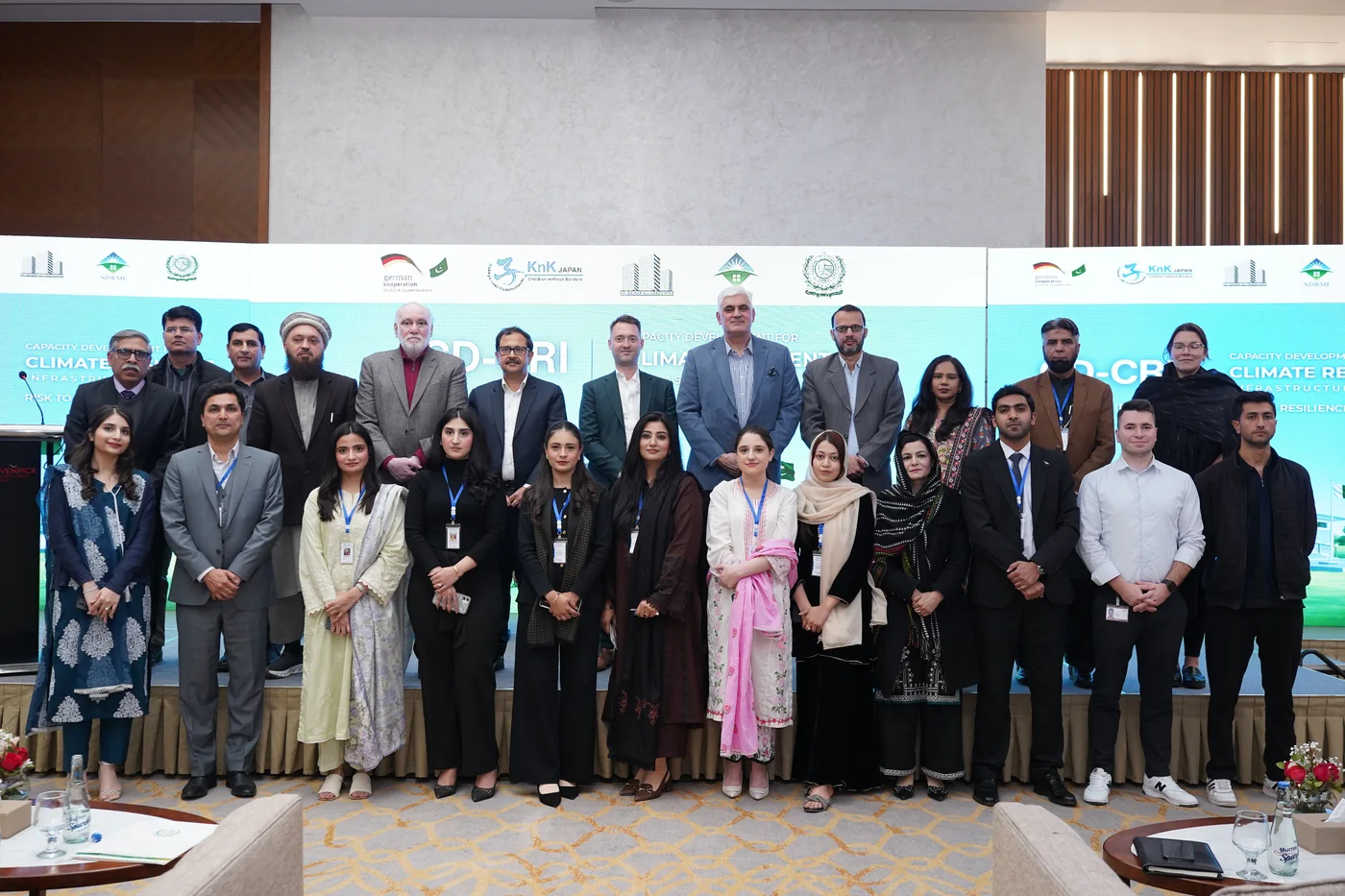
Partners from KnK Japan, the Pakistan Engineering Council and the NDRMF mark the signing of the CD-CRI Memorandum of Understanding in Islamabad.
Photo: KnK Japan
On 28 January 2026, Islamabad hosted a high-level stakeholder consultation on Capacity Development for Climate-Resilient Infrastructure (CD-CRI), marking a major step towards strengthening Pakistan's public infrastructure against climate and disaster risks. The consultation was organised by Kokkyo naki Kodomotachi (KnK) Japan in partnership with the Pakistan Engineering Council (PEC), the National Disaster Risk Management Fund (NDRMF) and the Deutsche Gesellschaft fuer Internationale Zusammenarbeit (GIZ) GmbH, with technical support from Dr Qaiser Ali Associates. Senior officials, practising engineers and development partners attended, among them PEC Chairman Waseem Nazir, NDRMF Chief Executive Officer Bilal Anwar, GIZ's Dr Nicolai Dellmann and Alex Forbes of the UN Resident Coordinator's Office.
At the centre of the day was the introduction of a data-driven Structural Health Assessment (SHA) system, aligned with the Building Code of Pakistan 2021 and designed to digitise the way public building safety and resilience are assessed. Rather than relying on ad hoc inspections, the SHA system gives trained engineers a consistent, evidence-based method to score and map the vulnerabilities of schools, hospitals and other essential facilities, so that limited public resources can be directed to the buildings that need them most. Stakeholders also discussed how to integrate climate risk data, disaster risk financing and inclusive approaches into everyday infrastructure planning.
The consultation witnessed the signing of a Memorandum of Understanding between KnK Japan, the PEC and the NDRMF to institutionalise climate resilience nationwide and to chart a roadmap for the wide adoption and long-term sustainability of the SHA system. Speaking at the event, PEC Chairman Waseem Nazir described resilience as a national commitment rather than a project outcome, and said the initiative was equipping engineers with modern tools to safeguard lives, infrastructure and communities against escalating climate and disaster risks. He also reflected that resilience had once been treated as little more than a buzzword, and that he now saw KnK Japan as a light in the tunnel for the sector.
Supported by the German Federal Ministry for Economic Cooperation and Development (BMZ) through GIZ, the initiative will pilot digital assessments in Khyber Pakhtunkhwa and Punjab, working towards safer, climate-resilient public infrastructure across Pakistan. The consultation set the agenda for the technical training, university engagement and continuing professional development that followed later in 2026, turning a shared commitment in the room into a practical programme of work in the field.